

Why Your Headache Might Be a Shoulder Problem: Understanding Referred Pain
Have you ever had a headache near your temples or a dull ache in your jaw, only to find that pressing on the painful area doesn’t help? Perhaps the pain you are experiencing is coming from another region of the body.
We recently sat down with Louise Spindler, a Myotherapist at Hopscotch Fitness Burwood, to discuss trigger points and referred pain. We also discussed how we may treat trigger points with dry needling, cupping and/or myofascial release techniques.
What is a Trigger Point?
To understand referred pain, we need to understand trigger points — those hard, tender "knots" in your muscles.
"In the textbooks, trigger points are a hyper-irritable spot in the muscle... a little nodule within a taut band," Louise explains. "It’s generally caused by overloaded muscles or damage."
When a muscle is stuck in this contracted position, it creates a "traffic jam" in your body. The tightness blocks blood flow, which means waste products can’t leave and fresh nutrients can’t get in to heal the area. This can send out distressed signals to our brain that can be experienced as muscle pain.
Is my jaw pain coming from my neck?
Referred pain is when the brain misinterprets the location of a pain signal. This can occur because different parts of our body can have the same nerve supply. As Louise pointed out:
"Your brain might interpret this trigger point as potentially pain somewhere else... you might think, 'Oh, I’ve really got this headache,' but it could actually be referred pain from a trigger point in your upper trapezius [shoulder]."
What are some common trigger point referral patterns?
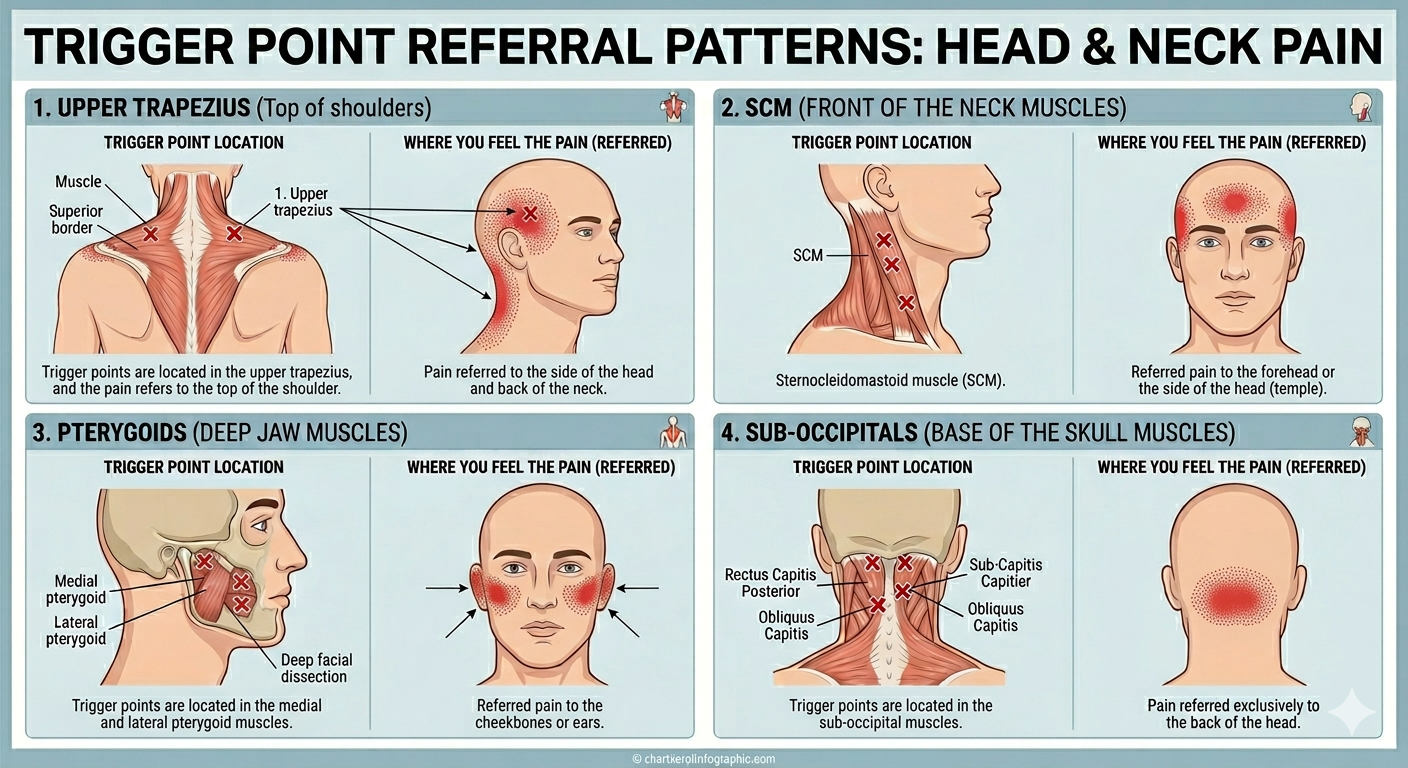
Upper Trapezius (Top of shoulders) -> Side or top of the head
SCM (Front of the neck muscles) -> Forehead or the side of the head
Pterygoids (Deep jaw muscles) -> Cheekbones, ears, or "sinus" pain
Sub-occipitals (Base of the skull muscles) -> Back of the head
How do we fix trigger points that are causing a headache?
Myotherapists and Osteopaths can use a variety of tools to break the cycle and clear the "traffic jam":
Ischemic Pressure:Applying firm pressure (with a hand or elbow) for 30–60 seconds to temporarily block blood flow. When released, a "whoosh" of fresh blood flushes the area.
Myofascial Release: Using a shearing force to separate the skin and fascia (the "glad wrap" of the body) from the muscle, allowing layers to slide freely again.
Dry Needling: Using a needle as thin as a hair to tap into the trigger point. This often causes a "twitch response" that instantly releases the muscle tension.
Cupping: Creating negative pressure to pull tissue layers apart and desensitize angry nerves.
Is One Treatment Enough?
The short answer: It depends.
If your pain came from a one-off slip or fall, you might be "one and done." However, most of us deal with maintaining factors—like sitting at a desk for 40+ hours a week or other repetitive positions.
"We just want a nice amount of movement," Louise says. Variety is the secret to keeping trigger points at bay. Whether it’s using a sit-to-stand desk, taking regular tea breaks, or using a foam roller at home, movement is medicine.
Referred neck, jaw or head pain
If you have persistent pain that doesn't seem to resolve with localised treatment, it might be time to look elsewhere. Chat to us here at Heads Up Osteopathy Box Hill South or Louise at Hopscotch Fitness Burwood about your trigger points and referred pain.