

An evidence informed Osteopathic approach to migraine management- part 1
Chronic migraine is a complex neurological event that requires an individualized management strategy, the search for relief can be tough. Migraine management typically involves a team of healthcare professionals to help the patient manage their symptoms, identify their migraine triggers and to explore underlying contributing factors.
Manual therapy and exercise prescription has its place in the management of migraine with recent literature demonstrating positive outcomes (reductions in frequency and severity of migraine attacks) with minimal side effects (Chaibi et al., 2011). There has also been substantial evidence showing that an increase in physical activity reduces migraine symptoms (Song & Chu, 2021).
The best outcomes for migraine management are individualised and literature has shown that there is no ‘one size fits all’ approach that proves superior (Song & Chu, 2021).
This aligns well with Osteopathy, as Osteopathic treatment and management is guided by principles, informed by literature and applied in an individualised manner to the patient in front of us.
What the research says about migraine, manual therapy and exercise prescription
Manual therapy and exercise prescription is safe.
One of the primary benefits of manual therapy and exercise prescription is its safety profile. Hands-on therapy and physical exercise are non-invasive and most patients experience only minor, temporary soreness. This makes them viable options for those searching for a safe and active approach to migraine management.
Manual therapy can be as effective as medication, serving as a supportive adjunct.
Studies indicate that non-drug treatments like soft tissue work and joint mobilization can be just as effective at reducing the number of "migraine days" as some leading prescriptions (Chaibi et al., 2011). Please note this is not suggesting that we don’t need pharmacological treatment but rather that manual therapy could be a supportive adjunct working in tandem to improve a patient’s overall quality of life.
Physical exercise can prevent migraine.
Recent literature also showed promising evidence to suggest that increasing one's physical activity could be very helpful in the prevention of migraine “Among behavioral strategies, exercise, notably aerobic, has been pinpointed as a promising preventive treatment, with significant symptomatic improvements having been observed” (Song & Chu, 2021).
An Osteopathic approach to migraine management
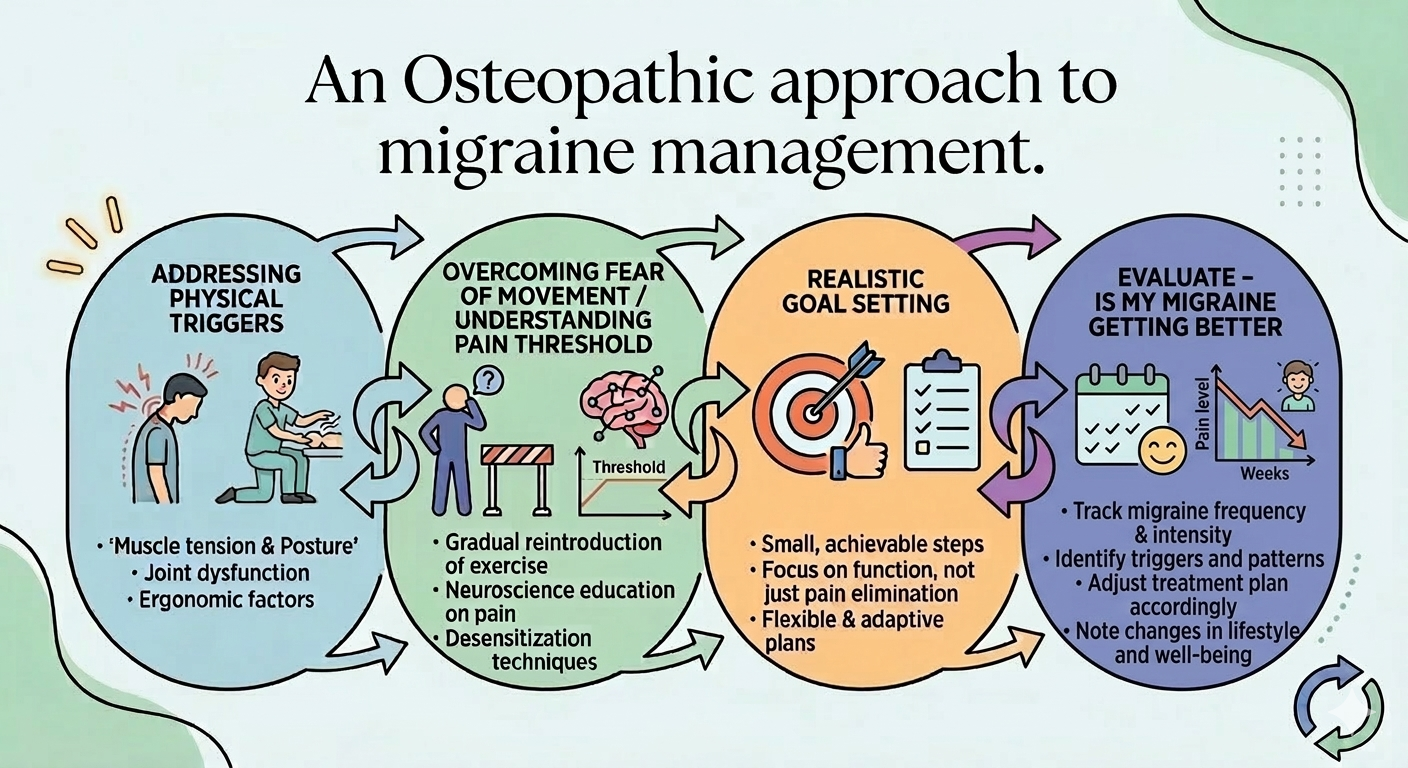
Uncovering the complex interplays of various body systems is something that Osteopathy can assist with, as we take a holistic ‘wide angled’ approach to patient care. We shift the focus from "treating the pain" to "supporting the person" and their individual needs. Below are just a few areas an Osteopath will address:
Physical migraine triggers
Many migraines are accompanied by neck tension or stiffness (Touche et al., 2024). While this isn't always the cause of the migraine, it can certainly act as a trigger or make the episode feel much worse. Manual therapy can focus on incrementally improving the way the neck and upper back move, helping to resolve the physical tension that often builds up between attacks.
Overcoming the fear of movement/ understanding the threshold of pain
One of the most significant hurdles for migraine sufferers is kinesiophobia, or the fear of movement. “The intentional avoidance of exercise is a frequent phenomenon among migraine patients... These studies reveal that avoidance of physical activity, especially high-intensity exercise, is associated with a higher frequency of migraine attacks, suggesting that physical inactivity could contribute to the perpetuation of migraine episodes” (Farris et al., 2019)
Osteopathy can provide a safe environment to help overcome the fear of movement by:
Reintroducing movement with a controlled, progressive and structured approach.
Desensitizing the nervous system by understanding the patient's threshold for pain, working below it whilst incrementally increasing the patient’s capacity.
Realistic goal setting
Setting realistic goals can be hard and having an objective third party to keep you realistic and accountable can make a world of difference. When setting goals it is important to work within your limits whilst also tickling the boundaries of your comfort zone.
Evaluate and review- is my migraine getting better?
Is your migraine ‘getting better’? What are we going to define as better? What are you hoping to achieve through treatment?
The use of questionnaires and quantifiable outcome measures can bring awareness to your progress (or lack there of), providing a great deal of clarity. Reviewing your treatment approach is important for everyone. You want to know you’re getting better and as practitioners we want to see you getting better.
Will Osteopathy fix my migraine?
While the research is promising for manual therapy and exercise prescription, everyone’s experience with migraine is unique and will typically require a multi disciplinary approach. We know that manual therapy is most effective when it is tailored to your specific triggers and physical history. Manual therapy also offers a way to move away from a purely reactive "rescue" mindset and toward a proactive, preventative strategy.
Managing migraine requires you to create a ‘migraine tool box’ that equips you with a variety of tools that you can draw upon as needed. Manual therapy and exercise prescription can be a very useful tools for you to have.
Stay tuned for more details about an Osteopathic approach to migraine management in part 2.
References:
Chaibi, A., Tuchin, P. J., & Russell, M. B. (2011). Manual therapies for migraine: a systematic review. The Journal of Headache and Pain, 12(2), 127–133. https://doi.org/10.1007/s10194-011-0296-6
Farris, S. G., Thomas, J. P., Abrantes, A. M., Lipton, R. B., Burr, E. A., Godley, F. A., Roth, J., Pavlovic, J. M., & Bond, D. S. (2019). Anxiety sensitivity and intentional avoidance of physical activity in women with probable migraine. 39(11), 1465–1469. https://doi.org/10.1177/0333102419861712
Song, T.-J., & Chu, M. K. (2021). Exercise in Treatment of Migraine Including Chronic Migraine. Current Pain and Headache Reports, 25(3). https://doi.org/10.1007/s11916-020-00929-w
Touche, R. L., de, B., Paris-Alemany, A., & Álvaro Reina-Varona. (2024). Incorporating Therapeutic Education and Exercise in Migraine Management: A Biobehavioral Approach. Journal of Clinical Medicine, 13(20), 6273–6273. https://doi.org/10.3390/jcm13206273