

Pain acts as a biological alarm system but the mechanisms of persistent pain vary to those of acute pain. We can think of persistent pain like an alarm system being stuck on long after the damaged tissue has healed. So what happens when we reach a persistent pain loop and can Osteopathy help persistent pain?
In a recent chat with Neuroscientist Dr. Brooke Keating (PhD in Neuroscience and Anatomy), we discussed the basics of nervous system sensitisation, why chronic pain is so difficult to treat with pharmacology alone and how targeted movement and manual therapy can help recalibrate an over-excited alarm (nervous) system.
Nervous system 101: the control centre and the messengers
Before discussing pain, we need a basic understanding of the nervous system:
Central nervous system: Your brain and spinal cord—the command centre.
Peripheral nervous system: The network of sensory and motor nerves running throughout the rest of your body.
Sensory nerves act like scouts, continuously feeding details about temperature, pressure and position back up to your spinal cord and brain. Your Central nervous system then processes this information and sends motor commands back out (e.g., "pull your hand off that hot stove").
In a healthy system, this feedback loop is balanced, protective and proportionate.
When the "Brakes" Fail: Acute pain vs. Peripheral & Central Sensitization
Pain signals travel as electrical impulses down a nerve cell until they reach a junction called a synapse. At the synapse, the signal converts to a chemical messenger (neurotransmitters, cytokines and chemokines) before firing off an electrical signal in the next cell.
Acute Pain: Protective & Proportionate
When you touch a hot plate acute inflammation kicks off. As the physical tissue heals over days or weeks, inflammatory markers drop, chemical signals settle and the pain subsides. This pain is protective in how it limits your range of motion and the pain is proportionate to the injury.
Persistent Pain: A stuck accelerator that isn’t functional
In persistent pain the nerve’s signalling pathway can lose its ‘internal brake system’. Instead of quieting down as the tissue heals, the nerve cells enter a state of sensitisation and continue to fire pain signals.
When these inflammatory chemicals persist without an active tissue threat, benign inputs can start triggering painful responses. The nervous system enters this persistent pain loop which can be very hard to stop.
Pharmaceuticals and physical therapy for persistent pain
Because neuropathic and persistent pain involve complex interactions between neurons, immune responses and high-level brain processing, Dr. Keating explains that pure pharmacology often falls short.
Dr. Keating points out that breakthrough pharmaceutical options for chronic pain remain limited precisely because pain is so multifaceted. Consequently, effective management relies heavily on combining physical movement, hands-on treatment and biological re-education. This is where we need to discuss neuroplasticity.
"Cells that fire together, wire together"
Your nervous system is not hardwired in stone. Through neuroplasticity, your brain and spinal pathways are constantly reshaping themselves based on input:
The Catch: If your body repeatedly experiences pain during a specific movement, those neural pathways reinforce themselves. The brain begins associating that movement with threat, creating fear-avoidance cycles (e.g., guarding your back and avoiding a hip hinge because of a past lift injury).
The Solution: Neuroplastic pathways work both ways. By introducing safe, non-threatening input, you can unlearn protective guarding patterns and dial down nervous system excitation.
While structural pruning and rapid learning are most pronounced in childhood, the adult brains retain the continuous capacity to adapt and rewrite signalling loops. So yes, we can teach an old dog new tricks!
The Osteopathic approach: calming the storm
From an Osteopathic perspective, chronic pain isn't just a structural issue in the muscles or joints—it's an overloaded communication loop between the peripheral tissues and the central nervous system. Manual therapy directly engages this loop through several mechanisms:
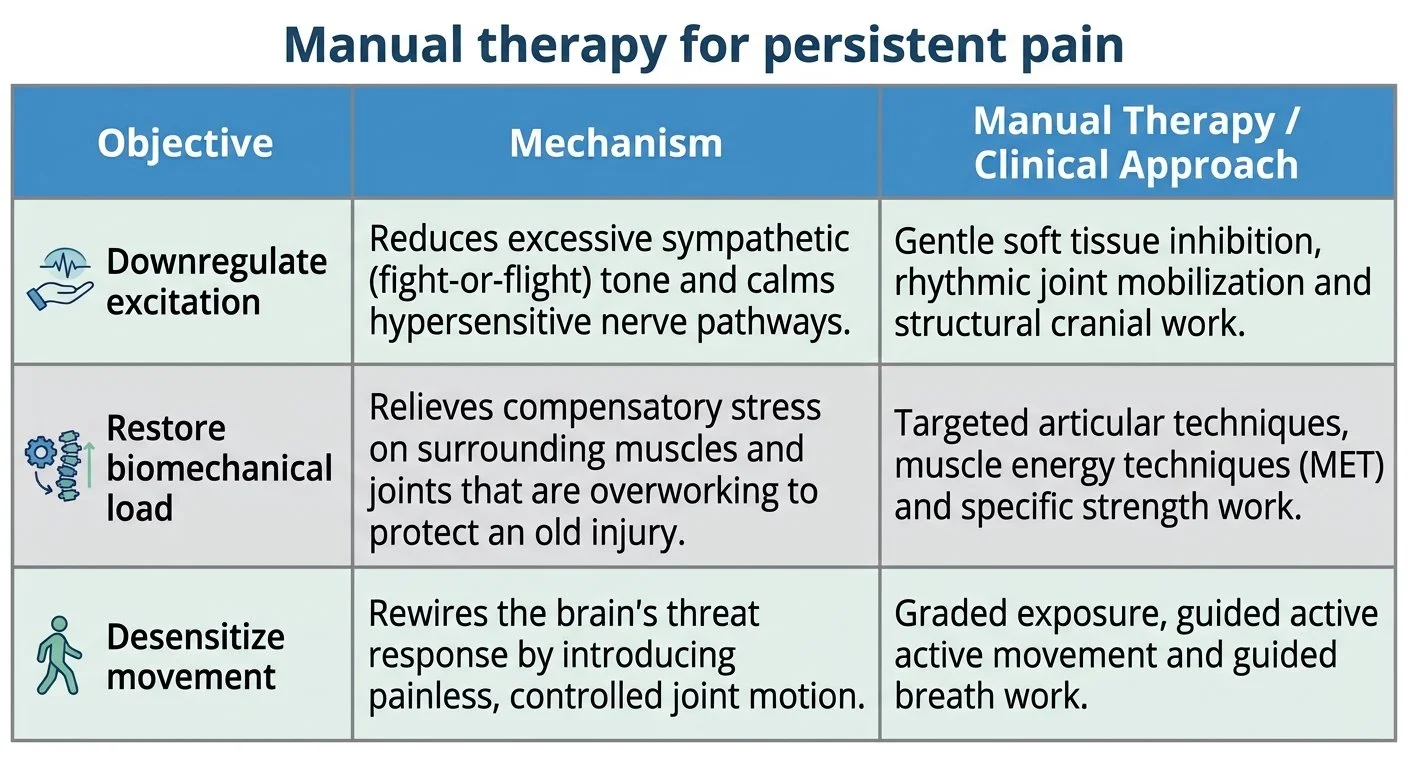
By combining hands-on techniques with progressive movement, manual therapy can deliver a safe, non-threatening sensory feedback directly to your control centre—helping your brain re-apply the brakes to an overactive nervous system.
Osteopathy treatment for my persistent pain
If you are dealing with persistent pain, remember that your body isn't broken, it is confused. Your body is trying to protect you from a threat/ injury that no longer exists.
The journey away from persistent pain is typically multidisciplinary, having a manual therapist like an Osteopath on your team can be of great benefit. With the right combination of hands-on care, graded exercise and time, you can guide your nervous system back into balance.