

Understanding The Grind: An Osteopathic perspective on managing teeth grinding (bruxism)
Do you ever wake up with a dull headache on the side of your head and/or with a tight jaw? You may be grinding your teeth at night. Teeth grinding is also known as bruxism, it is an involuntary rhythmic or spasmodic grinding or clenching of the teeth. This growing phenomenon is largely driven by internal factors (eg: chronic stress and anxiety) and modulated by external factors (eg: posture and resting muscle tone). Bruxism can occur whilst you are awake or asleep.
“Awake bruxism is associated with nervous tic and is related to stress” (Dinesh R, 2024)
“Although the pathology and physiology of awake bruxism are unknown, stress and anxiety are major risk factors.” (Dinesh R, 2024)
Why does my jaw hurt?
Normally our jaw muscles follow a healthy rhythm of contraction and relaxation. This allows blood to flow freely, delivering oxygen and clearing out metabolic waste products. However, when you are clenching your teeth for long periods, that natural rhythm is broken. We witness a sustained muscle contraction leading to decreased blood flow and a buildup of metabolic waste products in the muscles. This build up of by-products in the jaw muscles causes symptoms of pain, lethargy and even spasms.
Why are we clenching our jaw muscles?
The tooth contact would normally signal the jaw muscles to disengage but in someone with bruxism this reflex is inhibited and the jaw muscles continue to contract despite tooth contact.
“The neuromuscular reflexes present in the event of functional activities protect the dental structures from injury. However, in the case of bruxism, this protective mechanism does not seem to be present, or the reflex threshold is somewhat increased, which results in a decreased impact on the activity of the muscle” (Okeson J, 2013)
A multi disciplinary approach to teeth grinding / bruxism
Bruxism is a complex movement disorder and there is no "magic bullet" cure. The best management for bruxism is a collaborative team approach.
A successful management plan often includes:
Dentists: To provide occlusal splints that protect the dental enamel from trauma.
Osteopaths: To manage muscular pain, joint mechanics, associated neck tension, postural imbalances and dysfunctional behaviours.
Psychologists/Counsellors: To address the underlying stress or anxiety triggers.
Sleep Specialists: To investigate if the grinding is linked to breathing disorders eg: obstructive sleep apnea.
Osteopathy and teeth grinding /bruxism
Persistent stress is a vicious self perpetuating cycle that is hard to break. After a prolonged time in a distressed state we start to normalise the high level of stress and the body forgets what the comfortable base line used to feel like.
This is where hands-on Osteopathic treatment can be of assistance.
Jaw muscle over engagement can be caused by stress and anxiety, this can be thought of as a ‘central driver’ as the message for the jaw muscles to activate is coming from our brain. The message can also go the opposite way, over active jaw muscles can send a message to our brain adding to our stress and anxiety. Excessive jaw muscle engagement that feeds into stress and anxiety can be thought of as a ‘peripheral driver’.
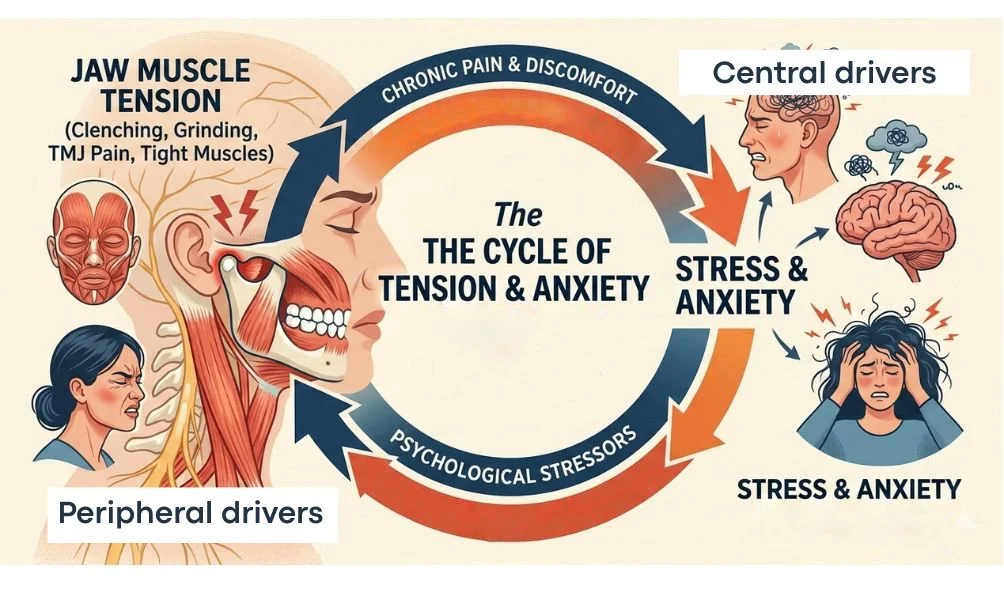
Targeted hands on work can help break this cycle, helping a patient return to and remember their comfortable base line.
So I just massage the tight jaw muscles?
Not quite. Fully releasing all of the chronically tight muscles in the head, neck and jaw region can do more harm than good. Causing a patient too much pain in the treatment can also make chronic pain and tightness worse. Instead it’s a finessed hands on approach with the aim to:
Restore postural balance
Address counter productive behaviours/ maintaining factors
Systematically reduce muscle tension whilst being aware of unstable joints
Create a realistic rehab program that promotes patient empowerment
Discuss a realistic multi disciplinary management strategy
Teeth grinding / Bruxism management in summary
It won’t be an overnight fix but you can improve your teeth clenching/ bruxism disorder.
We need to:
Protect your teeth
Address your stress and anxiety (central drivers)
Address your tight and dysregulated muscles (peripheral drivers)
Ensure that you don’t have an underlying breathing disorder
We can move away from "just enduring the pain". Let’s look at the root cause, create a plan and move towards long-term relief.
References:
Dinesh Rokaya. (2024). Introduction to the Masticatory System and Dental Occlusion. Wiley-Blackwell.
Okeson, J.P., Management of Temporomandibular Disorders and Occlusion. 7th Ed. 2013, St. Louis, Missouri: Morsby.